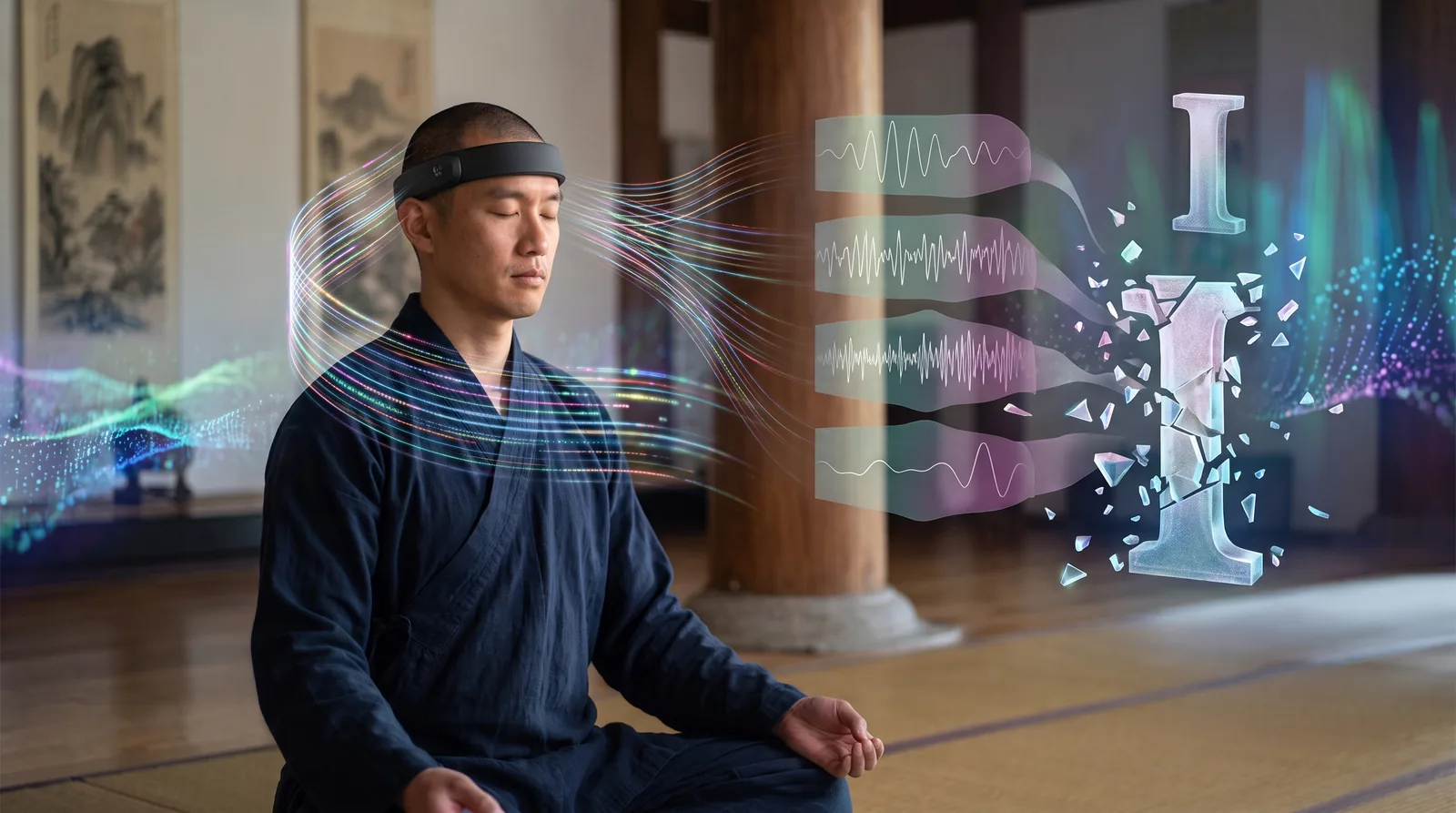
Deconstructing the “I”: What Brainwaves Reveal About Chan Intuitive Inquiry
EEG studies reveal how Chan intuitive inquiry deconstructs the self — the ancient doctrine of anattā, made visible in the brain's own rhythms.
For thousands of years, the ultimate riddle of Buddhist philosophy has been the radical doctrine of anattā — the realization that what we often grasp as an enduring, autonomous "self" is an elaborate cognitive illusion.
In the East Asian Chan tradition, this insight is not treated as an abstract philosophical debate, but as the living target of direct spiritual excavation. Through the specialized practice of Huatou, or Intuitive Inquiry Meditation, practitioners relentlessly investigate core existential questions such as "Who is reciting the Buddha's name?" or "What was my original face before my parents were born?" The purpose is never to arrive at a clever intellectual answer, but rather to evoke the "Great Doubt" — a state of intense, non-conceptual perplexity that collapses ordinary dualistic thinking and discursive self-referential narratives. Yet to modern thinkers, transcending this self-referential identity sounds elusive, raising the question of how the human brain can systematically dismantle its own architecture of selfhood while remaining acutely awake, lucid, and functional.
In contemporary cognitive neuroscience, this continuous process of ego-construction is termed self-schema processing, closely mirroring what early Buddhist psychology classified as clinging to the five aggregates. Whenever an individual reflects on their character, replays past grievances, or calculates their social status, a dedicated network known as the Default Mode Network, anchored within the medial prefrontal cortex and posterior cingulate cortex, becomes highly active. Electrophysiologically, this narrative self is woven together through distinct rhythms: slow theta waves mediate episodic memory and internal dialogue, alpha rhythms gate internal attention, and fast beta or gamma frequencies bind active emotional appraisal. The untrained brain reflexively categorizes every passing concept into rigid bins of "me" versus "not-me," fueling an unending cycle of defensiveness, anxiety, and craving.
Seeking to uncover whether long-term contemplative practice fundamentally alters this neural architecture, researchers at The University of Hong Kong's Buddhist Practices and Counselling Science Lab, led by Dr. Junling Gao, Venerable Dr. Hin Hung Sik, and Dr. C. G. Lee, conducted landmark electroencephalography (EEG) investigations published in Heliyon (2023) and Behavioral Sciences (2025). In the 2023 study, researchers presented both long-term Chan practitioners and non-meditating control participants with personality trait words, tracking their cortical microstates as they judged whether each adjective described themselves or another person. While control subjects exhibited a dramatic neural divide — marked by surges in frontal theta oscillations and heightened late-positive potentials whenever an adjective applied to themselves — expert Chan practitioners showed an almost seamless neural response. In the meditators' brains, self-referential evaluations were processed with the same objective equanimity and reduced discursive theta activity typically reserved for neutral acquaintances, demonstrating a functional dissolution of the rigid self-other boundary.
Building upon these insights, the lab's 2025 investigation tracked the real-time neural transitions of expert monastics as they moved through the traditional Chan method of chaining rhythmic vocal chanting with sudden inward inquiry. The continuous EEG recordings captured a striking dynamic shift: the moment practitioners turned their awareness backward from vocal recitation to silently ask "Who is reciting?", fronto-parietal brain networks transitioned into synchronized alpha and low-theta frequencies, mirroring the traditional state of "silent illumination" wherein sharp alertness coexists with conceptual quietude. Advanced source localization further revealed a functional decoupling between the anterior medial prefrontal cortex — the seat of the cognitive ego — and posterior sensory integration centers. The brain remained completely awake and perceptive, yet the neural mechanism responsible for stamping sensory experience with the label of "I" was momentarily silenced.
For practitioners and spiritual seekers walking this path, these empirical findings offer vital contemplative guidance. They demonstrate why attempting to answer a koan intellectually is counterproductive; conceptualizing an answer immediately reactivates the frontal theta narrative circuits that the inquiry is designed to dissolve, meaning the inquiry must be maintained as an open, non-verbal question mark rather than a puzzle to solve. Furthermore, the laboratory protocol highlights the deep wisdom of combining rhythmic chanting with inquiry, using the steady cadence of recitation to establish baseline attentional stability before turning awareness inward. Ultimately, these neuroimaging insights remind us that everyday feelings of insecurity, pride, or defensive anger are merely ephemeral projections of an overactive self-schema network. When we hold these surges in spacious, non-clinging awareness, the noisy machinery of identity naturally recedes into stillness, revealing the profound freedom that lies beyond the construct of the self.
References
- Gao, J., Leung, H. K., Wu, B. W. Y., Hung, J., Chang, C., & Sik, H. H. (2023). Long-term practice of intuitive inquiry meditation modulates EEG dynamics during self-schema processing. Heliyon, 9(9), e19545. https://doi.org/10.1016/j.heliyon.2023.e19545
- Lee, K. C. G., Sik, H. H., Leung, H. K., Wu, B. W. Y., Sun, R., & Gao, J. (2025). Neural Pattern of Chanting-Driven Intuitive Inquiry Meditation in Expert Chan Practitioners. Behavioral Sciences, 15(9), 1213. https://doi.org/10.3390/bs15091213
Article by
Andrew Bakaki
Buddhist Practitioner
Subscribe to the newsletter
Receive new posts and our monthly digest, straight to your inbox.
Unsubscribe anytime.
Comments
No comments yet. Be the first to share a reflection.
Only members can comment.