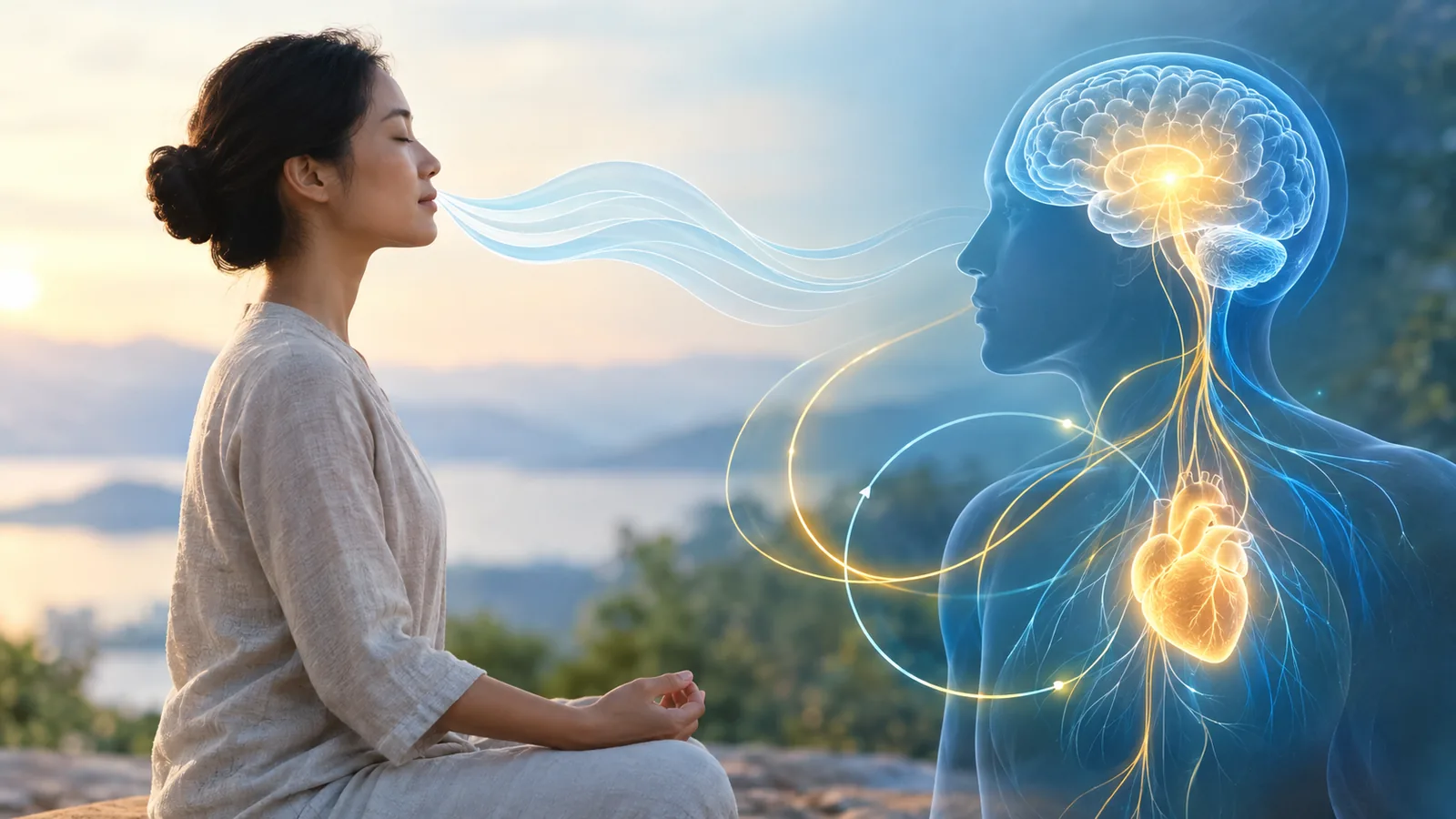
Why Watching Your Breath Feels Unnatural: Neuroscience Explains the Ancient Art of Breath Alignment
A 2026 HKU study maps the Ānāpānasati Sutta onto interoceptive neuroscience—explaining why watching the breath feels unnatural and how the ISAAA model resolves the tension between attention and the autonomic nervous system.
Almost every seeker has encountered the same confounding paradox upon first sitting down on a meditation cushion. The instructor gives a deceptively simple instruction: "Just observe the breath naturally without controlling it."
Yet the moment we turn our conscious attention toward respiration, spontaneity vanishes. The chest tightens, breathing becomes stiff and artificial, and an involuntary tug-of-war begins between our conscious will and our autonomic nervous system. Instead of serenity, we are met with subtle performance anxiety and somatic strain. Novices often conclude that they are simply "bad at meditation," unaware that this tension is not a personal failure—it is an unresolved neurophysiological conflict.
A pioneering 2026 paper from the Buddhist Practices and Counselling Science Lab at The University of Hong Kong (HKU), authored by Venerable Dr. Hin Hung Sik, Sabin Maharjan, and Dr. Junling Gao in the journal Mindfulness, addresses this exact obstacle.
Introducing the ISAAA Model (Interoceptive Sensitivity for Attentional–Autonomic Alignment), the HKU team demonstrates how the opening instructions of the ancient Ānāpānasati Sutta provide a precise neurobiological roadmap for resolving the conflict between voluntary attention and involuntary physiology.
The Dual Control Dilemma: Why the Breath Resists Observation
Unlike cardiac contractions or peristalsis, respiration is uniquely poised at the crossroads of our conscious and autonomic nervous systems.
At the foundational level, respiration is regulated by the involuntary autonomic network, an intricate neural circuit anchored deep within the brainstem. Specialized respiratory rhythm generators—most notably the pre-Bötzinger complex—act as the body's subconscious pacemaker, continuously firing to maintain vital metabolic homeostasis. Without requiring conscious consent or wakeful attention, this ancient system fine-tunes ventilation in real time, precisely balancing systemic oxygen absorption, carbon dioxide clearance, and arterial blood pH. It operates beneath ordinary awareness, ensuring uninterrupted survival even during sleep, exertion, or profound distraction.
Superimposed upon this primal rhythm is the voluntary cortical network, which grants conscious, top-down control over the respiratory apparatus. Driven primarily by the motor and premotor cortices, this pathway allows intentional modulation of breathing to serve complex behavioral and expressive ends. It enables voluntary interventions such as breath retention, deliberate pacing, or a deep, purposeful sigh to relieve acute somatic tension. Furthermore, this cortical override provides the delicate motor control required for vocalization, coordinating airflow with precision to allow for speech, song, and intentional contemplative practice.
When an untrained mind attempts to "watch the breath," the brain frequently misinterprets this attentional command as a motor directive. Instead of passive reception, the frontal cortex exerts an awkward top-down control over the brainstem's rhythm. The practitioner falls into an exhausting bind: they are exerting deliberate effort to pretend they are not exerting effort. The HKU team discovered that ancient Buddhist texts anticipated this dilemma over two millennia ago.
The Two Phases of the ISAAA Model
The researchers mapped the first four steps (tetrad) of the Ānāpānasati Sutta directly onto modern interoceptive neuroscience (the brain's perception of internal bodily signals), organizing the practice into two distinct, sequential phases:
Phase 1: Building the Metacognitive Platform (Steps 1 and 2)
In the classical contemplative framework, this foundation rests on the twin directives of parimukhaṃ satiṃ upaṭṭhapetvā—establishing mindfulness directly before oneself—and pajānāti, clearly knowing whether the breath is long or short. Rather than an instruction to deliberately alter, lengthen, or control respiration, pajānāti denotes an attitude of bare, lucid discernment. The practitioner refrains from forcing diaphragmatic breathing or chasing an idealized respiratory pattern, cultivating instead a stable, decentered stance that witnesses each inhalation and exhalation exactly as it unfolds in the present moment.
Neurophysiologically, this non-interfering awareness acts as a vital circuit breaker between conscious intent and autonomous physiology. Adopting a detached observer perspective, the brain transitions into resting posterior alpha oscillations, a signature electrophysiological state of wakeful, relaxed alertness that requires no artificial adjustment to the respiratory rate. This newly established metacognitive buffer prevents executive networks from interfering with subcortical rhythms, allowing the prefrontal cortex to surrender its instinctive urge to hijack the brainstem's automatic pacing mechanisms.
Phase 2: Attentional–Autonomic Alignment (Steps 3 and 4)
In the classical progression of practice, the practitioner transitions from isolated breath tracking to sabbakāyapaṭisaṃvedī, experiencing the entirety of the physical vessel, and passambhayaṃ kāyasaṅkhāraṃ, allowing all bodily activities and agitations to progressively settle into stillness. This phase represents a pivotal shift from narrow focal awareness to a wide, receptive somatic field. Rather than straining to manufacture a state of peace through sheer willpower, the practitioner simply opens attention to the full landscape of internal bodily sensation, creating the experiential conditions under which physical unrest naturally subsides on its own.
From a neurobiological standpoint, this whole-body attunement engages the core architecture of interoception once metacognitive stability has been established. As conscious presence expands through the body, a rich stream of visceral sensory feedback ascends along vagal afferent pathways, routing through the nucleus tractus solitarii (NTS) directly to the insular cortex—the brain's primary hub for mapping the internal somatic state.
This deep insular integration triggers a profound autonomic recalibration. Attuning directly to somatic signals prompts the cardiovascular and respiratory systems to fall into spontaneous harmony, converging toward a 0.1-Hz cardiorespiratory resonance. This shift elevates vagally mediated heart-rate variability (HRV), disengaging sympathetic arousal and synchronizing the rhythmic pulsations of the heart with macroscopic oscillations throughout the brain.
The critical insight of the ISAAA model is directional sequence: calm and autonomic coherence cannot be directly commanded by force; they must be invited through prior metacognitive attunement. Novices who attempt to force slow, calm breaths at the very start consistently induce autonomic distress.
A Kalyāṇamitra Practice Guide
As spiritual companions walking this path, how can we apply this research during our daily practice?
First, do not begin by fixing the breath. When you sit, do not immediately attempt "deep diaphragmatic breathing." If your breath is shallow, fast, or irregular, allow it to remain so. Your sole responsibility in the opening minutes is metacognitive acknowledgment: "Breathing in short, I recognize a short breath." Give your brainstem permission to breathe without cortical intervention.
Second, listen to the heartbeat and sensation first. Before expecting deep tranquility, train your interoceptive channels. Feel the pulse in your palms, the contact of your body on the cushion, and the expansion of the ribs. Developing body-listening sensitivity is the biological prerequisite for autonomic relaxation.
Finally, let the body calm the mind, not vice versa. Realize that the soothing of bodily formations (kāyasaṅkhāra) is a natural downstream consequence of broad, non-interfering presence. When attention and autonomic signaling fall into alignment, the nervous system shifts spontaneously into deep, regenerative stillness.
The Buddha's practical instructions were fundamentally aligned with our underlying physiology: when we stop struggling to control our breath, the organism already knows how to return home.
Original Scientific Reference: Sik, H. H., Maharjan, S., & Gao, J. (2026). Interoceptive Mindful Breathing: The ISAAA Model for Attentional–Autonomic Alignment. Mindfulness.

Article by
Andrew Bakaki
Buddhist Practitioner
Subscribe to the newsletter
Receive new posts and our monthly digest, straight to your inbox.
Unsubscribe anytime.
Comments
No comments yet. Be the first to share a reflection.
Only members can comment.