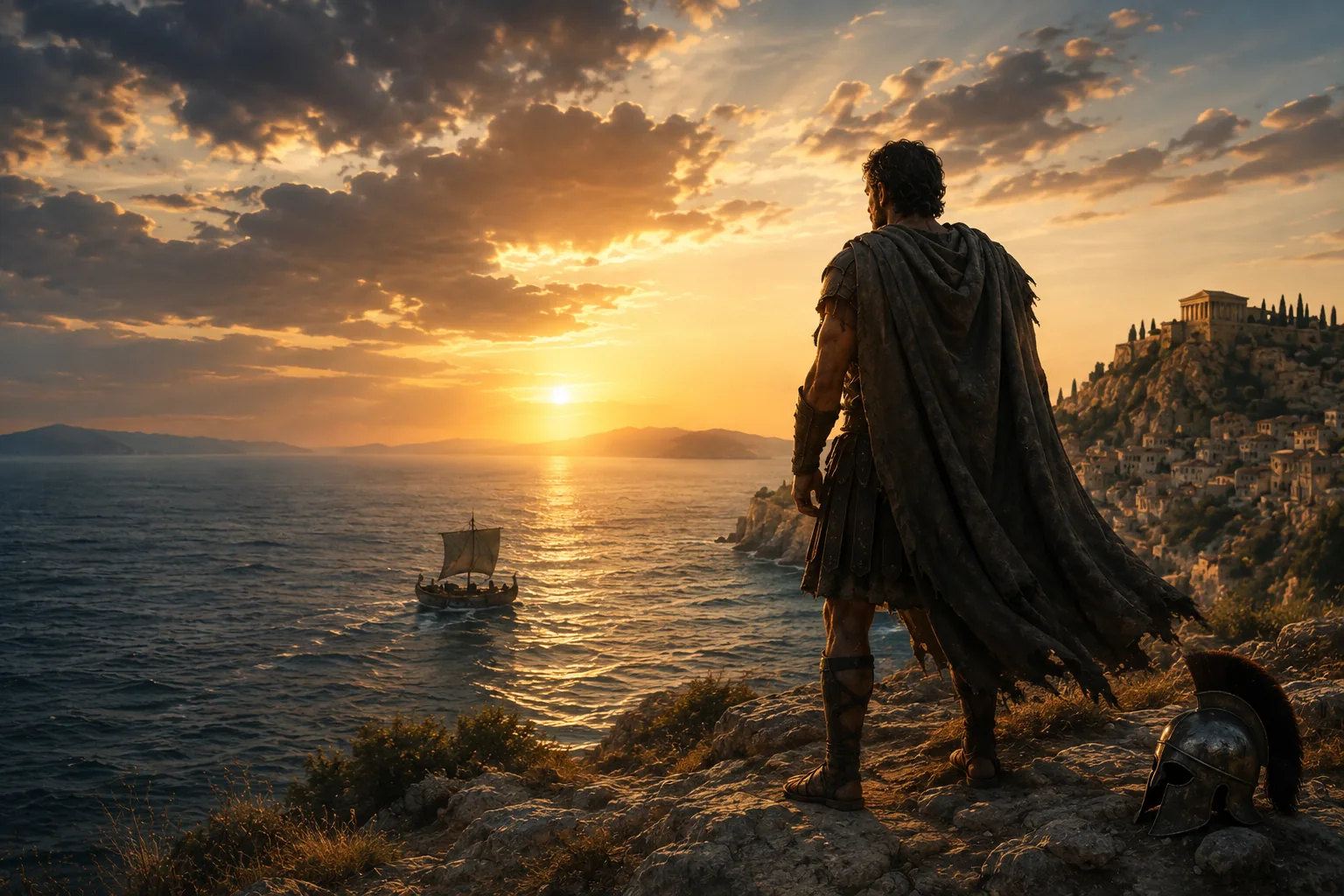
The Long Way Home: A Buddhist Reflection on Christopher Nolan's The Odyssey
A Buddhist reflection on Christopher Nolan's The Odyssey — on suffering, impermanence, and the quiet discovery that home may not be a place we reach, but a presence we learn to inhabit.
There are stories that entertain us, and there are stories that silently leave an imprint in us. They remain somewhere beneath the surface of the mind, returning days later as a question, a memory, and perhaps even a feeling we cannot quite name. Christopher Nolan's The Odyssey is, for me, one of those stories.
On the surface, it is an heroic journey of war, gods, monsters, adventures, love, loss, and the desperate struggle to return home. As a Buddhist, I found myself thinking less about the wonders of the journey but more about what the journey reveals about the human condition. Underneath the mythology is something deeply familiar: a human being struggling with suffering, attachment, identity, fear, pride, love, and the longing to find his way home.
Odysseus spends years trying to return to Ithaca. He wants to see his wife, Penelope. He wants to see his son, Telemachus. He wants to return to his kingdom and reclaim the life he once knew. There is something deeply human in this longing. We all have our own version of Ithaca. We tell ourselves that when we reach a certain place, achieve a certain goal, find the right person, make enough money, heal a particular wound, or finally resolve a particular problem, then we will be able to rest. We are constantly moving toward some imagined destination where we believe life will finally become complete.
The Buddha invited us to look more carefully at this incessant movement of the mind. What exactly are we expecting the future to give us? Why do we believe that the next achievement, the next relationship, the next experience, or the next destination will finally settle the restless heart? The Buddha's teaching of dukkha points toward this fundamental dissatisfaction within conditioned existence. It does not mean that life is nothing but suffering. Rather, it reminds us that everything we experience is changing, and therefore nothing impermanent can provide us with a permanent sense of security. We enjoy beautiful moments, but they pass. We love people, but they change and eventually leave us. Our bodies change. Our circumstances change. Even our understanding of who we are changes. And so, like Odysseus, we keep travelling.
What makes the story even more powerful is that Odysseus is not simply travelling across the sea. He is carrying something with him. The wounds of war cannot simply be left behind when the battle ends. There are experiences that stay inside us long after the circumstances that created them have disappeared. There is grief, guilt, fear, regret, and memory. We often imagine that healing means returning to the person we were before something happened to us. But perhaps healing is not a return. Perhaps healing is learning how to live differently with what has happened. The past cannot be erased, but our relationship with the past can change.
This is something I find deeply resonant with Buddhist practice. We suffer not only because painful things happen to us, but because of the way the mind continues to hold them. We replay conversations. We revisit mistakes. We imagine alternative futures. We ask ourselves what might have happened if we had chosen differently. We resist what has already happened because some part of us believes that if we think about it enough, we can somehow change it. But the past does not live anywhere except in the present moment as memory. The event has passed; what remains is our relationship with it. Mindfulness allows us to begin seeing that relationship clearly.
Perhaps this is why the sea becomes such a powerful image in the story. The sea is constantly moving. It can be calm one moment and violent the next. It cannot be controlled. In many ways, the human mind is like this. A thought appears, followed by another. A memory arises. A fear emerges. A desire pulls us forward. An emotion changes our perception of the world. We spend much of our lives trying to control this inner ocean. We try to suppress unpleasant thoughts, eliminate uncomfortable feelings, and create conditions in which we will never have to experience uncertainty. But meditation teaches us something different. Perhaps we do not need to control every wave. Perhaps we need to learn how to remain present while the waves rise and fall.
This is one of the great gifts of mindfulness. It does not promise us a mind that never becomes disturbed. Instead, it gives us the possibility of knowing that the disturbance is happening. There is a difference between being angry and knowing that anger is present. There is a difference between being afraid and knowing that fear is present. There is a difference between believing every thought and simply observing that the mind is thinking. This small distance between experience and awareness can become the beginning of freedom.
The monsters in The Odyssey can also be understood in this way. They are external creatures in the mythology, but they can also represent the forces that live within us. We all have our own monsters. They may not look like the creatures of ancient mythology, but they can be just as powerful. Anger, pride, greed, jealousy, fear, resentment, craving, and the desire to control can take possession of the mind. In Buddhism, these are often understood through the three poisons of greed, aversion, and delusion. They distort our perception and keep us trapped in patterns of suffering.
Perhaps the greatest monsters are therefore not the ones that Odysseus encounters on his journey, but the ones he carries within himself. This is what makes the story more than an adventure. The external journey becomes a mirror of an internal one. The further Odysseus travels, the more he is forced to confront the consequences of his choices, the limits of his power, and the fragility of everything he is trying to protect.
This also complicates the idea of the hero. Odysseus is courageous and intelligent, but he is not perfect. His strengths are accompanied by weaknesses, and his actions have consequences. There is something deeply Buddhist about resisting the temptation to divide people into simple categories of good and bad. Human beings are more sophisticated than our labels suggest. We can be compassionate in one moment and selfish in another. We can act with wisdom today and foolishness tomorrow. We can cause harm while believing that we are doing what is necessary.
The Buddhist teaching of anatta, or non-self, challenges our tendency to turn temporary qualities and actions into permanent identities. We say, "I am a good person," or "I am an angry person," or "I am a failure," as though there is some fixed entity inside us that never changes. But when we look closely, we find processes rather than permanence. Thoughts arise and disappear. Emotions arise and disappear. Habits change. Perspectives change. The person we were ten years ago is not exactly the person we are today.
This does not mean that our actions do not matter. Quite the opposite. Karma reminds us that our actions have consequences. What we think, say, and do shapes the conditions of our lives and affects other beings. We cannot simply declare ourselves heroes and escape responsibility for the suffering we have caused. At the same time, we are not required to remain prisoners of our past. We can acknowledge what we have done, understand the conditions that produced it, make amends where possible, and choose differently.
This brings us back to the central question of the story: What does it actually mean to go home?
For Odysseus, home initially appears to be a physical destination. Ithaca is the place he left, the place where he believes his life belongs. But by the time he returns, everything has changed. He has changed. His family has changed. His kingdom has changed. The world has changed. There is no possibility of simply stepping back into the past.
And perhaps this is one of the most difficult truths of human life. We often want to go back. We want to return to the relationship before it became complicated, to the body before it aged, to the family before someone died, to the version of ourselves before we made a particular mistake. We imagine that happiness would come if only we could recover what once existed. But impermanence does not negotiate with us. Everything moves.
Buddhism does not teach us how to stop impermanence. It teaches us how to see it. And there is tremendous freedom in that seeing. When we understand that everything changes, we begin to hold things differently. We can love without pretending that we can possess forever. We can appreciate beauty without demanding that it remain. We can experience happiness without desperately trying to freeze it in time. We can grieve without believing that grief means something has gone wrong with life. Impermanence becomes not merely something to fear, but something that makes each moment precious.
Perhaps this is why the idea of home takes on a deeper meaning for me. Home may not ultimately be a place. It may be a quality of presence. We spend so much of our lives somewhere other than where we actually are. Our bodies are sitting in one place while our minds are living in yesterday or tomorrow. We replay what has already happened and rehearse what has not yet happened. We are constantly travelling through the landscapes of memory and imagination.
Meditation offers another possibility: coming home to the present moment.
Not when everything has been resolved. Not when we have finally achieved everything we want. Not when life becomes safe and predictable. But now. This breath. This body. This moment. Whatever is actually here.
There is something profoundly simple about this, and perhaps that is why it is so difficult. We are conditioned to believe that happiness is somewhere ahead of us. We are trained to pursue, improve, acquire, achieve, and become. Yet the practice of mindfulness gently asks us to stop for a moment and notice that life is already happening.
The deepest journey, then, may not be the journey from Troy to Ithaca. It may be the journey from unconsciousness to awareness. From reactivity to understanding. From attachment to letting go. From pride to humility. From fear to compassion. From the endless desire to control life to the wisdom of meeting life as it is.
This is perhaps what makes an ancient story like The Odyssey feel so contemporary. The ships have changed. The weapons have changed. The landscapes have changed. But the human mind has not changed very much. We still want. We still fear. We still cling. We still fight. We still lose. We still grieve. We still fall in love. We still search for meaning. And we still spend much of our lives trying to find our way home.
The Buddhist path does not promise us a perfect Ithaca waiting at the end of the journey. It offers something more subtle and, perhaps, more liberating: the possibility of seeing clearly. To see the ways craving creates suffering. To recognize the stories we construct around "me" and "mine." To understand that thoughts and emotions are passing experiences rather than permanent identities. To cultivate compassion for ourselves and others. To develop the wisdom to know what can be changed and the acceptance to release what cannot.
Perhaps, then, the real tragedy would not be that Odysseus takes so long to reach home. Perhaps it would be if he returned without having changed.
Because the purpose of a journey is not always to arrive where we intended to go. Sometimes the journey changes the person who is travelling.
And perhaps this is true for us as well.
We may spend years searching for happiness, security, recognition, love, success, or peace. We may cross our own oceans and encounter our own monsters. We may lose people we thought would always be with us. We may discover that some of the things we spent our lives pursuing cannot give us what we imagined they would.
But somewhere along the way, we may discover something quieter.
That home is not necessarily a destination.
That peace is not the absence of difficulty.
That freedom is not having everything under control.
That wisdom is not knowing all the answers.
And that perhaps the journey was never really about getting somewhere else.
Perhaps it was about learning how to be fully here.
So when I think about The Odyssey through the lens of Buddhist practice, I do not see only the story of a man trying to return home. I see a reflection of all of us. We are all travelling. We are all carrying things we cannot see. We are all trying, in one way or another, to find a place where we can finally rest.
But maybe the home we are searching for is closer than we think.
Perhaps it is found in the moment when we stop running from ourselves.
In the moment when we allow the past to be the past.
In the moment when we stop demanding that the future save us.
In the moment when we meet our fear without becoming it, meet our sorrow without rejecting it, and meet our joy without trying to possess it.
In the moment when we breathe and realize that, despite everything, we are here.
The journey continues.
But for a moment, we can stop searching.
We can breathe.
And come home.

Article by
Andrew Bakaki
Buddhist Practitioner
Subscribe to the newsletter
Receive new posts and our monthly digest, straight to your inbox.
Unsubscribe anytime.
Comments
No comments yet. Be the first to share a reflection.
Only members can comment.